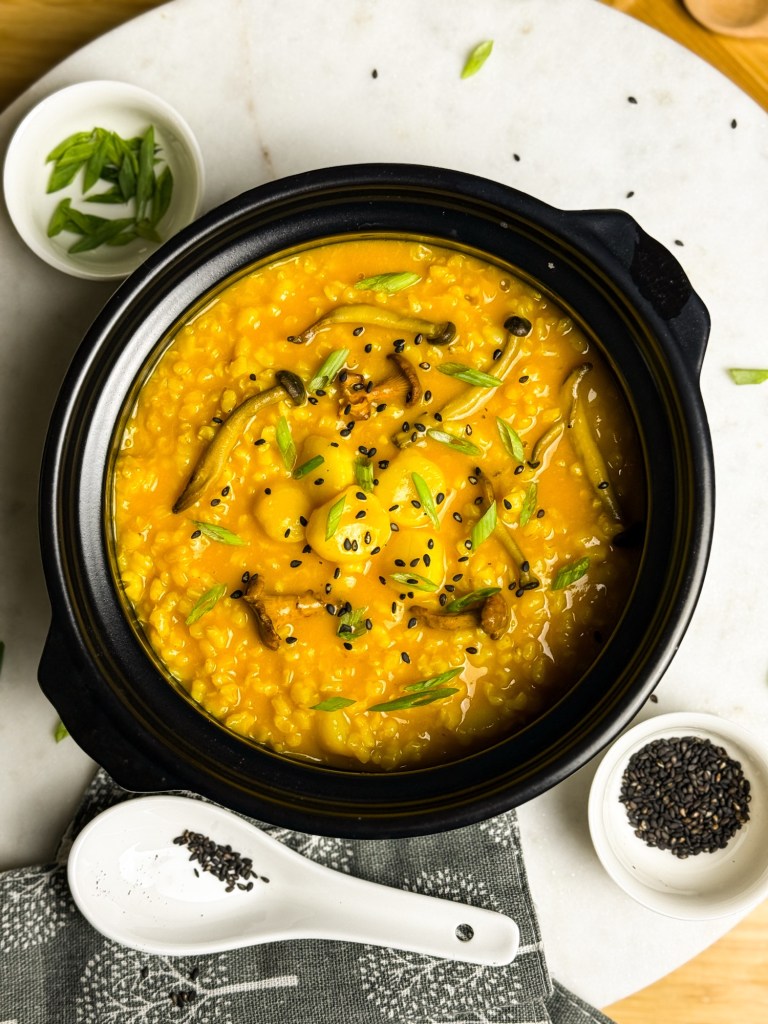
Comforting. Silky. Nourishing.
This Pumpkin Congee with Scallops and Mushrooms is the kind of cozy bowl that warms you from the inside out. Roasted kabocha pumpkin lends its natural sweetness and golden hue, while tender scallops and mushrooms bring depth and umami to every spoonful. Whether you’re easing into autumn or simply craving something soothing and savory, this congee feels both luxurious and homey.
Why You’ll Love This Recipe
- Comfort in a bowl: Creamy pumpkin base with tender rice and seafood makes for a cozy, one-pot meal.
- Umami depth: Scallops and mushrooms add complexity to the naturally sweet kabocha.
- Flexible and forgiving: Works with brown or white rice and any mix of mushrooms you love.
- Nourishing simplicity: Naturally gluten-free, hearty, and packed with flavor which is perfect for cold weather or recovery days.
- Great for make-ahead meals: Keeps well for days, making it ideal for meal prep or leftovers.
The Significance of Congee
Congee (粥, zhou in Mandarin, jook in Cantonese) is one of the most beloved comfort foods in Chinese cuisine. It’s often the first solid food given to babies and the go-to dish when someone is feeling unwell due to it being gentle, warm, and soothing to both body and spirit.
Across regions of China, and in communities throughout Asia, congee takes countless forms: plain and simple for breakfast, savory with meats and preserved eggs, or sweetened with red beans or dates. No matter the version, congee is about nourishment and care, a reflection of the idea that food can comfort as much as it can sustain.
This pumpkin version leans into that same spirit, with roasted kabocha adding natural sweetness and golden color, while scallops and mushrooms bring depth and umami. It’s a bowl that bridges tradition and seasonality, especially during fall when chanterelles and pumpkins are at their peak.
Pumpkin vs. Kabocha
While “pumpkin” and “kabocha” are often used interchangeably in recipes, they’re quite different in flavor and texture.
- Kabocha (also called Japanese pumpkin) has a naturally sweeter, nuttier flavor and a dense, velvety texture once cooked. It gives congee a richer, creamier mouthfeel and a more vivid golden color.
- Regular pumpkin tends to be milder, more watery, and slightly less sweet which is great in pies, but it won’t deliver the same depth in savory dishes.
If you can find kabocha (often in Asian markets), it’s absolutely worth using here. But if not, substitute with acorn squash or sugar pumpkin for a similar comforting result.
Seasonal Note
In the Pacific Northwest, chanterelle mushrooms are at their best in the fall. Their earthy aroma and buttery flavor pair beautifully with the sweetness of kabocha. If they’re out of season, swap in shiitake, cremini, or shimeji mushrooms for a similar depth of flavor and a splash of autumn color.
Ingredients
Serves: 6–8
Prep Time: 10 minutes
Cook Time: 1½ hours
Ingredients
- 8 cups chicken stock
- 350 g kabocha
- 1½ cups brown rice (or 1 cup white rice)
- 227 g scallops
- 150 g assorted mushrooms, such as shimeji, shiitake, or chanterelle
- ½ tsp salt or 2 tbsp fish sauce, plus more to taste
- Green onions, slivered for garnish
- Toasted black sesame, for garnish
Equipment
- Large stock pot or Dutch oven
- Baking sheet (for roasting kabocha)
- Chef’s knife and sturdy cutting board
- Immersion blender (or countertop blender)
- Wooden spoon or spatula
- Ladle for serving
Instructions
Roasted Kabocha
- Roast kabocha pumpkin whole in the oven at 350°F (175°C) for 45 minutes or until tender.
- Cut the kabocha into quarters, remove seeds and fibrous strands.
- Scoop out the flesh and set aside. Discard the shell and/or stem.
To Make the Congee
- Bring chicken stock to a boil in a pot.
- Add roasted kabocha and use an immersion blender to blend until fully combined.
- Add rice to the pot, and lower heat to a simmer for 30–45 minutes.
- Add scallops, mushrooms, and salt (or fish sauce). Simmer for another 10–15 minutes, until scallops are cooked through and mushrooms are tender (but not soggy).
- Serve hot with green onions and black sesame seeds.
Tips & Tricks
- For thicker congee: Simmer longer or reduce liquid slightly.
- For smoother texture: Blend the soup again briefly after adding rice.
- Make it vegetarian: Use vegetable broth and skip the scallops, adding tofu instead.
- Don’t skip roasting: It enhances the kabocha’s natural sweetness and makes peeling easier.
Storage & Make Ahead
- In the fridge: Store cooled congee in an airtight container for up to 3 days. Reheat gently with a splash of water or broth to loosen.
- In the freezer: Freeze in portions for up to 1 month. Thaw overnight and reheat on the stovetop.
Make ahead: Roast the kabocha and cook the rice separately a day ahead; combine and simmer before serving.

 Hey It's Jen Lou